Welcome back to the Christmas traditions series. Today, we’re looking at Christmas in the Philippines.
In the Philippines, Christmas is not squeezed into a few days. It spans months and fills homes, churches, streets, and entire neighborhoods. People begin talking about Christmas early, and once it starts, it stays in view for a long time. The heart of it is still the same. Christians gather to remember the birth of Jesus Christ, and many of the best-loved customs are built around church worship, family, and community.
The Philippines is one of the most strongly Christian nations in Asia, and most Christians there are Catholic, with Protestant communities as well. That Christian foundation matters because it explains why Christmas is not only widespread but deeply rooted in church life.
To understand Christmas in the Philippines, you have to know how Christianity became part of the country’s story. Before Spanish rule, the islands had their own local religions and customs. Trade connected the islands to many parts of Asia, and Islam had already taken root in the southern Philippines, especially in Mindanao and the Sulu region. Then, in the 1500s, Spanish exploration reached the islands. In 1521, Ferdinand Magellan arrived, made alliances with local leaders, and introduced Christianity in that early period. Spanish rule expanded more fully later, and over the following centuries, Catholicism spread widely across the islands.
Churches were built, towns formed around parishes, and the church calendar shaped public life. Over time, Christmas became one of the most important seasons of the year, not only as a religious event, but as a shared community season, with customs repeated year after year.
One of the best-known parts of Christmas in the Philippines is the long lead-up to Christmas Day. In many places, the Christmas season begins in September. People sometimes call these the “ber months” because September, October, November, and December all end the same way. You will hear Christmas songs early, see decorations appear in stores, and notice a steady build in anticipation.
This long season is not only about shopping or music. It also creates a long runway for religious preparation, especially for those active in church life. Churches begin to decorate. Choirs prepare carols. Families plan gatherings and travel, and many start setting aside money for meals and gifts well in advance.
A major religious tradition in the Philippines is Simbang Gabi, also called Misa de Gallo. This is a series of nine early morning masses leading up to Christmas. These services usually begin on 12/16 and continue through 12/24. The masses are held before sunrise, and people wake up early to attend.
This tradition has deep roots. During Spanish rule, the schedule helped farmers who had to work early in the day. Holding mass before sunrise allowed people to attend worship before heading to the fields. Over time, it became one of the most beloved Christmas traditions in the country.
For many people, attending all nine Simbang Gabi masses is a serious personal goal. Some do it as an act of devotion, some as a family tradition, and some connect it with prayer requests. The atmosphere is often joyful but reverent. Churches are decorated. People sing. Scripture is read. The birth of Christ is centered again and again, not as a single day on the calendar, but as something the community prepares for together.
Outside the church after these early-morning masses, a particular kind of Christmas life emerges.
Food stalls often sell holiday treats like bibingka, a baked rice cake, and puto bumbong, a purple steamed rice snack usually served with butter, sugar, and grated coconut. These foods are closely tied to Simbang Gabi. People eat them with family or friends before heading home or going to work. It becomes a rhythm of worship and community, repeated morning after morning until Christmas arrives.
Another potent symbol of Filipino Christmas is the parol.
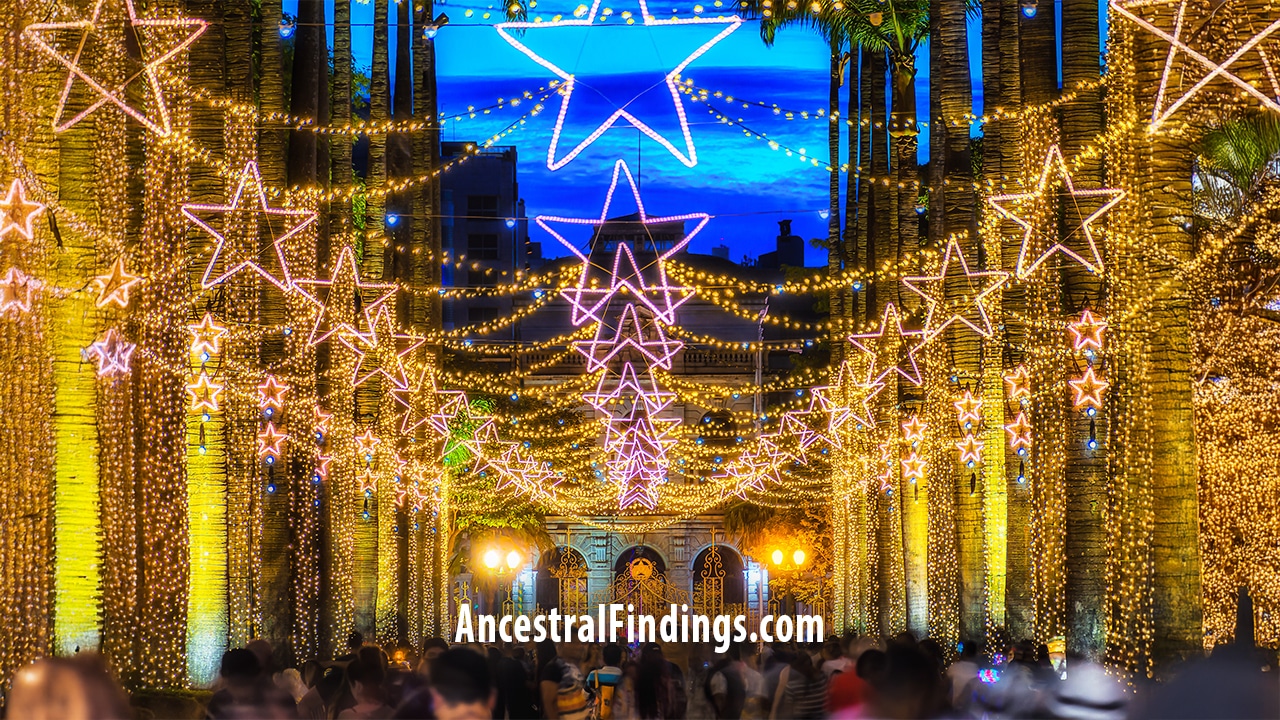
A parol is a star lantern, usually shaped like the Star of Bethlehem. It is one of the most recognized decorations in the Philippines. Parols are hung in windows, on porches, in churches, in businesses, and on street displays. Many are made from simple materials like bamboo and paper, though larger and more elaborate parols can be made from plastic, metal, or other modern materials.
The parol is not just decoration. It points directly to the Nativity story. It connects Christmas to the star that guided people to Christ. This is one reason the parol has remained central. It keeps the meaning visible, even in public spaces.
In some places, parol making becomes a community art. Families create them at home. Schools hold activities where children make small parols. Towns put up large displays. One of the most famous events connected to parols is the Giant Lantern Festival in San Fernando, Pampanga, held during the Christmas season. Large lanterns are built and displayed, and the competition becomes a major community event. Even in these large displays, the star theme still points back to Christmas and the story of Christ’s birth.
Another Christmas tradition in the Philippines is caroling.
Groups, often children or young people, go from house to house singing Christmas songs. In some places, they use simple instruments, like homemade percussion or small guitars. After singing, they may receive coins or small treats. The caroling is not only entertainment. It is a way for neighbors to connect and share the season.
In churches, carols are also central. Choirs prepare songs for Simbang Gabi and Christmas services. Some communities sing traditional Filipino carols, and others sing translated versions of carols known around the world. These songs often tell the story of Christ’s birth in simple language, making them easy to understand and easy to pass down.
Christmas Eve is an important moment in Filipino Christmas.
On 12/24, many families attend the final Simbang Gabi mass or a Christmas Eve service. For many Christians, this is the key worship moment of the season. Churches are full. The service centers on the Nativity. Scripture readings, prayers, and songs focus on the birth of Christ. People come dressed for church, often as families, and the feeling is both joyful and serious.
After church, many families gather for Noche Buena.
Noche Buena is the Christmas Eve meal, often eaten late at night, sometimes after returning from church. Families prepare it as a special meal, and it is one of the most anticipated parts of Christmas for many people. The foods can vary by region and family, but common dishes include lechon, a roasted pig, hamon, which is Christmas ham, queso de bola, a large round cheese often served at Christmas, and a wide range of noodles, rice dishes, and desserts. Some families prepare a large spread, and others keep it simple, but the goal is the same. People gather, eat, and spend time together.
This meal can stretch late into the night. People talk, laugh, and share stories. Children stay up later than usual. In many homes, Christmas feels like it arrives not at midnight on a clock, but in the moment the family finally sits together after church.
Christmas Day on 12/25 continues the celebration.
Many Christians attend church again on Christmas Day, especially families who treat Christmas Day worship as central. After that, the day often becomes a long sequence of visits, meals, and family time. In some areas, people visit godparents and older relatives. Respect for elders plays a strong role in Filipino culture, and Christmas becomes a time to honor parents and grandparents with visits, gifts, and attention.
Gift giving is part of Christmas, but it often emphasizes the family group rather than individual surprises. Many families set aside money for children’s gifts, and adults may exchange gifts as well. In some homes, gifts are simple. In others, they are larger, depending on the means. The heart of it is not displayed. It is care and togetherness.
The Christmas season in the Philippines also includes public displays and community events.
In cities and towns, you will see lights, decorations, and sometimes large Nativity scenes. Some churches and public spaces set up a belen, which is a Nativity display showing Mary, Joseph, the infant Jesus, shepherds, and the wise men. These displays can be small in a home or large in a church or town square. They keep the story of Christ’s birth in view.
Some communities also practice panunuluyan, which is a reenactment of Mary and Joseph seeking lodging. This may happen in church communities leading up to Christmas. People act out the story, moving from place to place, and then ending at the church, where the Nativity story is honored. This tradition keeps Christmas tied to Scripture and makes the story concrete for people watching, especially children.
The Philippines has also had a long experience with hardship, natural disasters, poverty, and periods of conflict. Christmas traditions have continued through those times, and in many places, Christmas becomes a season where communities support each other. Churches and groups organize gift drives, food distributions, and meals for people who need help. For Christians, this is often tied directly to the message of Christ’s coming and the call to love neighbors in practical ways.
Another important part of Filipino Christmas is the connection to family members who live far away.
Many Filipinos work overseas, and the country has a large community of overseas workers. During Christmas, families often feel that distance strongly. Money sent home helps fund Christmas meals and gifts, but the emotional side is real too. People make calls, send messages, and plan visits when possible. Christmas becomes a season of longing and connection across distance, mixed with gratitude for what family members provide.
As the Christmas season continues, many people also look ahead to New Year’s, which is another major celebration in the Philippines. While Christmas centers on Christ’s birth for Christians, the holiday stretches from Christmas through New Year’s, creating an extended season of family time, gatherings, and community events. For many households, the days between 12/25 and 01/01 are filled with visits and meals.
Even with all of these cultural layers, the Christian center remains clear in many places. Churches remain crowded during Simbang Gabi. Christmas Eve services remain important. Nativity displays remain visible. The language of Christmas remains connected to Christ’s birth.
The Philippines also includes communities that are not Christian, especially in areas with a strong Muslim population. In those regions, Christmas is not observed in the same way. Still, across the nation, Christmas is widely recognized, and many people take part in public aspects of the season, even when their personal beliefs differ. In Christian-majority areas, Christmas remains one of the strongest shared traditions.
What makes Christmas in the Philippines stand out is not only how long the season lasts, but how closely it stays tied to church worship and community life. Simbang Gabi pulls people into nine days of preparation. The parol keeps the Star of Bethlehem visible across neighborhoods. Caroling brings voices to the streets. Noche Buena gathers families at the table after worship. Churches keep the Nativity story at the center, not as a background idea, but as the reason the season exists.
Christmas in the Philippines is a season built on repeated actions. People go to church early in the morning. People decorate with star lanterns. People cook special foods. People sing. People gather. The story of Christ’s birth is told again and again through worship, songs, and symbols that children learn early and adults keep carrying forward.
That is why Christmas in the Philippines does not feel like a quick event. It feels like a long season of preparation and celebration, with faith and family woven tightly through it, from the first early masses in December to the final gatherings after Christmas Day.