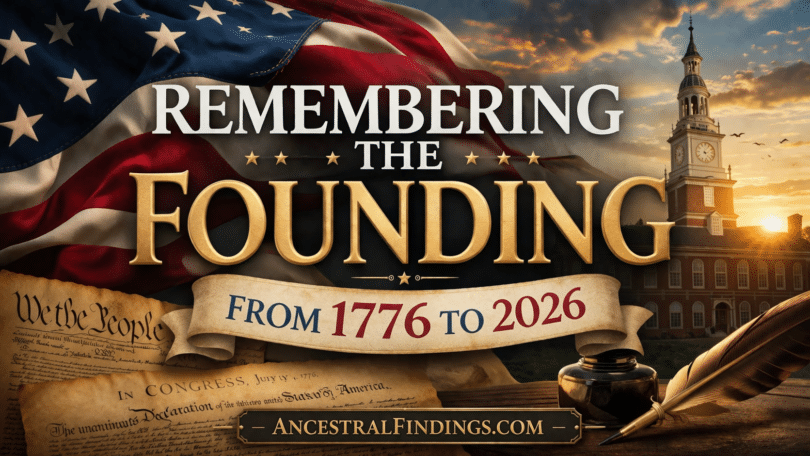
The founding of the United States is often treated as a closed chapter, something contained in a handful of documents, a few familiar names, and a short list of dates that everyone is expected to know. That version is easy to recognize, but it is much smaller than the real story. The founding did not stop when the Declaration of Independence was adopted, nor did it become fixed once the war ended. From the beginning, it was being carried forward in another way, through letters that were saved, papers that were organized, broadsides that were printed, speeches that were repeated, and collections that were built by people who understood that these years would not remain clear unless the record itself survived.
That is one of the most useful ways to approach the 250th anniversary. It is not only an opportunity to look back at what happened in the 1770s. It is also a chance to consider how those events were preserved, explained, and handed down. The founding has always depended on more than the original moment. It has depended on memory, selection, preservation, and the steady return of later generations to the documents and voices that remained. The official America250 effort frames July 4, 2026, as a national moment to reflect on the nation’s past and future, which makes this question especially fitting now.
From the start, the Declaration itself was part of that process. It was not merely approved and set aside. The National Archives notes that on the night of July 4, 1776, John Dunlap printed what became known as the Dunlap broadside, the first printed version of the Declaration, and copies were distributed immediately. The document was meant to move outward, not remain inside Congress. That early movement set the pattern for everything that followed. The founding would survive not only because it happened, but because it was printed, read, copied, collected, and preserved.
The founding as a record, not only an event
When people lived through the Revolution, they did not know they were producing a finished national story. They were dealing with immediate questions, urgent decisions, and uncertain outcomes. Letters were written because someone needed news from home. Political papers were drafted because a public case had to be made. Official records were kept because decisions had to be tracked. In the first instance, these materials were functional. They served the needs of the moment.
Yet the survival of the founding depended on those practical acts. The record did not appear all at once in an archive. It accumulated in personal hands. Families kept letters. States retained official papers. Printers preserved copies of texts that had first been issued for immediate political use. These choices were often local and personal, but together they formed the documentary base from which later generations would reconstruct the period.
That is why the founding can still be read with such richness today. It was not preserved only through monuments or later summaries. It was preserved because paper survived, because private correspondence remained in families, because public texts were reprinted, and because later institutions gathered what earlier people had kept. The National Archives continues to emphasize the documentary history of the Revolution and the Continental Congress, while the Library of Congress has assembled extensive digital collections that preserve both official and private materials.
This also explains why the founding has never been only one thing. It lives in official declarations and in household letters. It lives in printed broadsides and in rough drafts with crossings out and revisions. It lives in public language and in private reflection. To remember the founding well, all of that has to be kept together.
Thomas Jefferson and the problem of memory
No figure shows this more clearly than Thomas Jefferson. He is often remembered first as the principal drafter of the Declaration of Independence, and that place is secure. The National Archives notes that after Richard Henry Lee introduced the independence resolution on June 7, 1776, Congress appointed a Committee of Five to prepare a formal explanation, and Jefferson wrote the first draft. The Library of Congress preserves Jefferson’s papers, including his rough draft of the Declaration, which allows modern readers to see not just the final wording but the writing process itself.
That rough draft is important because it reminds us that even the most famous founding text was revised, debated, and altered. Jefferson did not hand down a finished sacred text in isolation. He produced a draft within a political process. Congress changed it. The final document became public, but the draft survived, and because it survived, later generations could see the founding not only as a proclamation but as a composition.
Jefferson’s place in memory did not end there. He also became one of the major interpreters of the founding in later life. He preserved copies of his letters, kept papers documenting his public service, and wrote reflectively about events he had participated in. That later stage is just as significant as the drafting moment. Jefferson was not only present at the creation of a foundational text. He also helped shape how the period would be remembered.
This creates a tension that runs through all historical memory. The people who preserve their own papers do not merely leave evidence behind. They also influence the future reading of events. Jefferson’s own understanding of the Revolution, of the Declaration, and of his role in both became part of the record that later readers inherited. That does not make the record false. It means that memory and preservation are never neutral. They are guided by human choices, even when those choices are careful and sincere.
The Library of Congress material on Jefferson and the Declaration reflects this double significance. It preserves the draft, but it also presents Jefferson as a conscious political writer whose language on liberty and rights became central to the later national understanding of the founding. That is part of why Jefferson remains so central to the 250th. He did not simply help found it. He helped shape the language through which the founding would be remembered.
John Adams, Abigail Adams, and the private side of preservation
If Jefferson shows how memory can be shaped by great public texts and later reflection, John and Abigail Adams show how it can be shaped by correspondence. Their papers survive not because they wrote with an eye toward public ceremony, but because letters that served immediate needs were kept and later recognized as historically rich. The Massachusetts Historical Society’s Adams Papers Digital Edition makes clear how extensive and valuable this correspondence is, and the Library of Congress provides guides to John Adams related collections as well.
That survival changed how the founding could be understood. Official documents tell readers what was resolved. Letters show what was uncertain. A declaration gives the finished statement. A letter reveals anxiety, impatience, domestic burdens, political tension, and the uneven pace of news. Abigail Adams’s famous March 1776 “Remember the Ladies” letter survives because private correspondence was preserved, and, because it was, later readers gained access to a voice that would otherwise have been largely lost from the public political record.
The same is true of later Adams correspondence. The long exchange between Adams and Jefferson in old age shows the founding moving from memory into interpretation. These are not letters written in the heat of 1776. They are retrospective, measured by time, and shaped by years of experience and disagreement. Yet they are also part of the founding record because they show how the founders themselves revisited what they had done.
This is one of the strongest reasons that remembering the founding cannot be limited to a few official texts. The founding was preserved in layers. Public documents survived, but so did family correspondence, reflective exchanges, and personal papers. That widened the historical picture. It meant that later generations could read the founding not only as a sequence of decisions, but as a human experience lived by people who did not yet know how the story would end.
Anniversaries and the shaping of national memory
Another part of the story is how anniversaries changed the way the founding was seen. Once a nation begins to mark its own beginning, the past is no longer only inherited. It is staged, described, and selected. Certain documents are read again. Certain names are elevated. Certain moments are treated as defining.
The fiftieth anniversary in 1826 is a striking example. By then, the Revolution was no longer in immediate memory for most Americans. It had entered public history. The deaths of John Adams and Thomas Jefferson on July 4, 1826, gave that anniversary a symbolic power that later generations could hardly ignore. Their passing on the same date tied their personal biographies to the national calendar, deepening the sense of the founding as a story already taking on the shape of legend. The Adams Papers record later efforts to gather and arrange Jefferson’s letters, showing how closely memory and documentation were linked.
By the centennial in 1876, the United States had changed dramatically. The founding could now serve as a point of national continuity after decades of territorial expansion, political conflict, civil war, and reconstruction. What the centennial celebrated was not simply 1776 as it had been lived. It was 1776, as later Americans needed to remember it.
The bicentennial in 1976 added another layer. By that point, archives, libraries, and documentary editions had expanded enormously. The founding could be encountered through exhibitions, facsimiles, collected papers, and a broader historical literature. The past was no longer remembered only through patriotic ritual or family tradition. It was increasingly accessed through institutions and documentary scholarship.
That is part of what makes 2026 different again. At 250 years, the record is both highly institutionalized and unusually accessible. America250 is framing the anniversary as a national act of reflection and civic participation, while archives and libraries make original materials available online at a scale no earlier anniversary could match. The founding can now be remembered through celebration, scholarship, and direct access to sources, all at once.
Archives, libraries, and the widening of access
The growth of archives and libraries changed the founding from inherited story into researchable history. What had once been scattered in private hands or small local collections became part of organized repositories. This did not happen instantly, and it did not gather everything. But over the nineteenth and twentieth centuries, preservation became more systematic. Institutions collected papers, cataloged them, edited them, and made them available in print and later in digital form.
That process changed not only access, but interpretation. When sources expand, the history expands with them. Earlier accounts often centered on a narrow range of public actors and public texts. Broader archival work made it possible to study newspapers, sermons, private letters, draft texts, legislative records, and the lived experience of people outside the central leadership. The founding could now be approached from multiple directions.
The Library of Congress guide to Declaration-related digital collections, the Jefferson Papers collection, and the National Archives’ Declaration history resources all reflect this widening access. They do not present only a finished national myth. They present drafts, versions, copies, and material traces of how the founding entered the record. The founding survives not only in polished form, but in the evidence of process.
That is especially important for readers today. Direct access to the record keeps later memory from becoming too smooth. It allows people to see revision, uncertainty, argument, and transmission. The founding becomes less distant, not because it is simplified, but because the surviving evidence is more immediate.
What gets remembered, and what gets left aside
Every act of historical memory involves selection. The founding has always been remembered through choices about emphasis. Some texts have been read over and over. Some voices have remained central. Others have been harder to hear, either because they were not preserved as fully or because later generations did not attend to them.
That is why the private materials, the letters, local papers, sermons, household records, and less-celebrated printed items remain so valuable. They resist a narrow memory. They keep the founding from shrinking into only a few polished lines and a short list of names. They remind readers that the period was larger, more uneven, and more human than later ceremonial memory sometimes suggests.
This is not an argument against the great documents. The Declaration deserves its place. The rough draft deserves its place. So do the correspondence of Jefferson, Adams, and Abigail Adams. The point is that the founding survives best when these materials are held together. Public language and private writing need each other. Broadside and archive need each other. National memory and documentary evidence need each other.
At 250 years, that fuller view is available in a way that earlier generations could only partly achieve. The record has been preserved through families, printers, archives, libraries, and digital institutions. The founding can be read at the level of public statement and at the level of personal experience. That is a rare gift of historical distance.
The founding of the United States is not alive because it changes with every generation. It remains alive because the record continues to be read. What began as immediate writing became preserved evidence. What was preserved became national memory. What became national memory can still be checked against the documents themselves. That is one of the strongest things the 250th can offer: not only celebration, but return. Return to the papers, the letters, the drafts, the public texts, and the private voices that carried these years forward.
And that is where the story remains strongest, not only in what happened, but in what endured.
Sources
- America250 states that July 4, 2026, will commemorate the 250th anniversary of the signing of the Declaration of Independence and presents the anniversary as a time to reflect on the nation’s past and future.
- The National Archives explains that the Declaration was printed as the Dunlap broadside on the night of July 4, 1776, and notes the surviving copies and the document’s early distribution.
- The National Archives describes the June 1776 process by which Congress appointed the Committee of Five and Thomas Jefferson drafted the first version of the Declaration.
- The Library of Congress preserves the Thomas Jefferson Papers, including the rough draft of the Declaration of Independence, and provides digital and exhibition material on Jefferson and the Declaration.
- The Massachusetts Historical Society’s Adams Papers Digital Edition preserves and publishes the correspondence of John Adams, Abigail Adams, and related family papers, including later Adams and Jefferson materials.
- The Library of Congress and the National Archives both provide broader access to founding-era materials, including Declaration-related collections and records of the Continental and Confederation Congresses.