Artificial intelligence is becoming an increasingly important part of genealogy, and one of the newest examples is MyHeritage’s Scribe AI. This tool is designed to help researchers work through old family history items that can be difficult to read, understand, or use effectively. For anyone who has stared at a faded letter, a handwritten church record, a worn gravestone, or an old family photo with little identification, that gets your attention quickly.
Genealogy has always required patience. It takes time to search for records, compare evidence, study names, sort out dates, and decide whether two people with the same name are really the same person. It also takes time just to read what is already in front of you. That is one reason this tool stands out. It is aimed at one of the most frustrating parts of family history research: getting useful information out of old material that is hard to read or interpret.
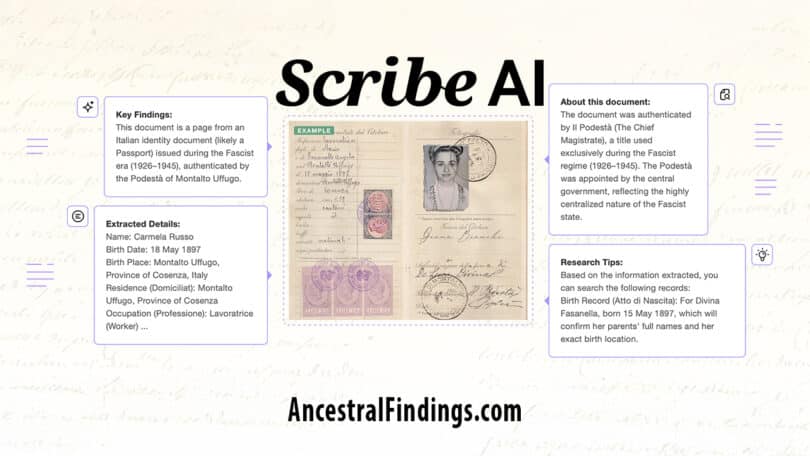
MyHeritage says Scribe AI can transcribe, translate, and interpret historical materials. That means it is not only trying to turn old text into readable words. It is also trying to explain what a document or image may contain, point out clues, and help a researcher see what deserves a closer look. That places it in a different category from a basic scanning tool or plain text recognition program.
For genealogists, that raises an important question. What can this actually do for real family history research? Not just in a product announcement and not only in a polished demonstration, but in the everyday work of studying old records, sorting through inherited papers, and trying to find one clue that moves the research forward. That is where Scribe AI becomes especially interesting.
Why This Tool Deserves Attention
Genealogists see new tools all the time. Some turn out to be useful. Some look impressive at first but do not change much in daily research. Scribe AI deserves attention because it is focused on a real research problem. Many family historians already have access to records and images. The challenge is that the material is often difficult to read, written in another language, poorly preserved, or full of clues that are easy to miss.
That is true across many areas of genealogy. A death certificate may be legible in some places and almost impossible to read in others. A family Bible page may have names packed tightly together in fading ink. A letter may mention relatives, places, or events in a casual way that only becomes valuable years later. A gravestone may be worn down enough that even a good photograph still leaves questions. Researchers often spend a great deal of time trying to pull meaning from material they already have.
That is the gap Scribe AI is trying to address. Instead of only helping you locate records, it aims to help you understand them. That is a meaningful shift. Genealogy websites have long been built around searching databases, building trees, and storing information. Now, larger platforms are moving toward tools that help interpret the contents of documents.
This also fits the direction genealogy is taking. Researchers now work with much larger collections than they did years ago. They also deal with more digital images, more records from other countries, more old family photos, and more inherited materials from relatives who may not have organized anything clearly. A tool that can assist with reading and sorting that material fits naturally into the way modern genealogy is done.
What Scribe AI Says It Can Do
According to MyHeritage, Scribe AI is designed to handle three major jobs. It can transcribe, translate, and interpret. Those three functions work together, and each one serves a different purpose for genealogists.
Transcription is the first step. That is the process of turning the visible text in a document or image into readable typed text. If a record is handwritten, faded, or difficult to follow, transcription can save a researcher a great deal of time. Even when a transcription is not perfect, it can still provide a strong starting point for closer review.
Translation is the next major function. Many genealogists work with ancestors from countries where records were kept in languages they do not read fluently. Even within the United States, a researcher may come across church records, immigration papers, or old letters written in another language. Translation can open those records to a wider group of researchers who may otherwise need outside help just to understand the basic content.
Interpretation is the feature that sets Scribe AI apart from an ordinary text tool. MyHeritage says it can identify names, dates, places, relationships, and historical clues, then explain what the material may be saying and suggest what a researcher might do next. That is the feature that makes many genealogists pause and pay close attention, because interpretation is where much of the research time goes. Reading a document is one thing. Understanding why it is useful is something else entirely.
This means Scribe AI is not only trying to tell you what the words are. It is also trying to explain what those words may mean in a family history context. That could be very helpful when used carefully. A line in a probate file may point to a daughter’s married surname. A passing mention in a letter may reveal where a relative was living at a certain time. A gravestone inscription may include religious language, military service, or family wording that gives context beyond the basic dates.
The Range of Materials It Can Handle
One of the strongest points in the launch is the range of material Scribe AI is built to analyze. MyHeritage says it can work with handwritten and printed documents, family letters, historical photos, gravestones, coats of arms, and certain record images on the MyHeritage platform. That broad range gives it more potential than a tool designed for only one kind of source.
This is important because genealogy research is rarely neat and uniform. Researchers do not spend all their time working with the same kind of document. One day it may be a census page. The next day, it may be a naturalization record, a letter from an aunt, a church register, or an image from a cemetery visit taken years ago. Each of those sources presents its own challenges.
Handwritten materials are one of the clearest uses. Many researchers inherit letters, notes, recipe cards, Bible pages, postcards, and personal papers that were never fully read or indexed. The writing may be cramped. The spelling may be inconsistent. The language may be old-fashioned or local. In some cases, the paper itself is damaged or stained. When that kind of material becomes easier to read, it becomes easier to use.
Printed records also benefit. Not every printed page is clear and easy to understand. Historical newspapers, old forms, foreign records, and copied pages from courthouse books can all be harder to read than expected. A tool that can capture the text and help identify the key details may save time, especially when working through many pages.
Gravestones are another strong use. Cemetery research often looks straightforward from a distance, but anyone who has done it knows that is not always the case. Stones weather. Names wear down. Dates become hard to read. Inscriptions may use abbreviations or symbols. Family markers may be broken or partly hidden. A better transcription and interpretation process could help researchers get more from the photographs they already have.
Historical photos may be one of the most interesting areas. Genealogists often have old family images with little or no labeling. While no tool should be trusted to identify people without evidence, a photo analysis feature could still help with period clues, visible objects, clothing, age estimates, and scene details. Sometimes those clues are enough to narrow down a time frame or suggest where a photo belongs in the family story.
How This Could Help in Everyday Genealogy
The real test of any genealogy tool is whether it helps in everyday workflow. That is where Scribe AI can be useful. It fits several common situations that family historians face all the time.
First, it could reduce the time spent deciphering difficult text. Many researchers can spend an hour on a single page, especially when dealing with poor handwriting, faded ink, or foreign-language records. Even a rough first pass by AI could speed up that process, because it gives the user something to review and correct rather than starting from scratch.
Second, it could help researchers notice clues they might otherwise miss. When people read an old document, they often focus on the most obvious information first. That usually means names and dates. But family history clues are often found in smaller details such as occupations, witnesses, neighbors, godparents, land descriptions, military references, or small place names that do not stand out right away. If Scribe AI highlights those details, it may help researchers get more from a record.
Third, it may help researchers who are newer to genealogy. Experienced genealogists already know how to read records with a more trained eye. They know to watch for relationships, legal wording, migration clues, and patterns that tie families together. Newer researchers often do not yet know what to look for. A tool that highlights potential clues can also help teach better document-analysis habits.
Fourth, it could support the organization. Many people have family material sitting in boxes, folders, or digital files that they have not fully reviewed. They know the items are important, but the volume is too large, and the reading is too slow. A tool that speeds up the first stage of analysis could help turn that backlog into usable research material.
That could be especially helpful for people who have inherited another person’s research. One of the hardest parts of genealogy is taking over a collection that was built by someone else. It may contain valuable information, but it may also be disorganized, poorly labeled, or full of documents saved without explanation. If Scribe AI can help reveal what those papers contain, it could help bring forgotten material back into active use.
Letters, Photos, and Family Papers
One of the most exciting parts of Scribe AI is not the obvious record work. It is what the tool might do with personal family material that has often been left unused. Family historians tend to focus heavily on official records, and for good reason. Census pages, probate records, deeds, and certificates are central to research. But some of the richest family details live outside those records.
Letters can be full of names, places, illnesses, jobs, church ties, moves, family disputes, and passing references that only show their value later. The trouble is that letters take time to read, especially when the handwriting is difficult. Some researchers postpone them for years. Others never get through them at all. A tool that makes those letters more accessible could uncover leads that have been sitting unnoticed in a family drawer.
Old photographs can be similar. People often inherit pictures with only a surname written on the back or no writing at all. Even when a photo cannot identify the person, it can still reveal useful context. Clothing may suggest a decade. A studio imprint may point to a location. A military uniform may hint at service. Household items, cars, buildings, or signs in the image may narrow the possibilities. Genealogists who work with photos know that even one small clue can help place an image correctly.
Family papers can also contain records that were never filed with a courthouse or in a database. Notes, funeral cards, church programs, business receipts, certificates, passport applications, and handwritten address books can all become valuable. These are the kinds of items families keep, but researchers sometimes postpone reading them because it takes time. Scribe AI may help bring more of that personal material into active research.
This may be one of the strongest reasons to pay attention to the tool. Official records are already central to most genealogy research plans. Personal papers are often the overlooked side of family history. They can hold the voice, personality, and daily life of the people we study. Anything that makes those materials more accessible has the potential to add more depth to family history research.
Research Value for Brick Walls
No AI tool can solve every brick wall. It cannot create missing evidence, restore destroyed records, or prove a relationship without documentary support. But it may still help with one of the most common problems in genealogy, getting more from the records you already have.
Many brick walls do not break because of one dramatic discovery. They break because several small clues come together. A witness’s name in a marriage record. A county mentioned in a letter. A church sponsor who turns out to be a relative. A land description linking two men with the same name. A translated word in a foreign record that changes the meaning of the entry. These are the kinds of details that are easy to overlook when a document is hard to read or not fully understood.
That is where Scribe AI could be helpful. It may encourage researchers to revisit material they already collected years ago and see it more clearly. A probate file that once looked too difficult may suddenly become usable. A family letter that seemed general may contain a precise location. A gravestone photo may offer more than the basic dates. Sometimes the answer is not in a new record at all. Sometimes it is in an old record that was never fully mined for evidence.
This could also strengthen a research habit good genealogists already know well: going back over older material with fresh eyes. A record that seemed unhelpful five years ago may look very different today, especially after more relatives, locations, and timelines have already been identified. If AI helps a researcher reexamine those earlier finds more effectively, that alone could make it worth trying.
How It Might Fit into a Good Research Process
The best use of a tool like Scribe AI is probably as a first pass assistant, not as a final authority. In a robust workflow, the researcher would begin with the original image, use AI to generate a transcription and interpretation, and then carefully compare the results against the source. From there, the researcher could extract the solid information, note any uncertain readings, and continue building the case using other records.
That approach keeps the source at the center. It also keeps the genealogist in control of the conclusions. AI can help make the text more accessible, point out clues, and speed up the first stage of analysis. The researcher still has to evaluate accuracy, judge the evidence, and decide what belongs in the family record.
This is especially important when several people in the same area share a name, when dates are unclear, or when a document is damaged. Genealogy depends on proof, context, and comparison. A tool can assist with those things, but it cannot replace the need for careful reasoning.
Even so, there is real value in the assistance. If a genealogist can spend less time struggling with handwriting and more time comparing evidence, that is a practical gain. It means more energy can be directed toward analysis rather than basic extraction.
It may also help researchers create better notes. Once a document is easier to read, it becomes easier to summarize accurately, attach the key details to the correct person, and record the next steps that need follow-up. Good genealogy is not only about finding records. It is also about capturing what those records show in a clear and usable way.
Privacy and Trust
Whenever people upload family documents and photos to a genealogy platform, privacy questions come up quickly. That is understandable. Researchers are often dealing with inherited material that feels personal, even when it is old. They may also be handling papers that mention living people or family situations that were never meant for public display.
MyHeritage has made privacy assurances about how uploads to this tool are handled, which will be important to many researchers. People want to know what happens to their family papers after they upload them. They want to know whether those images stay private, whether they become searchable, and whether the content is being used in ways they did not expect.
Still, trust is not built by one statement alone. Genealogists tend to be careful people, and they should be. Before using any new tool, it makes sense to read the company’s current privacy language, think about the kind of material being uploaded, and decide what is appropriate to share. Historical records and old family papers often feel safe to use. Newer items involving living relatives may call for more caution.
That does not mean the tool should be avoided. It means it should be used thoughtfully. Most genealogists already work that way, especially when dealing with sensitive family information. A little caution at the start is usually a good idea, especially when a new feature is still being explored by the genealogy community.
Why This Launch Could Be Important in 2026
Even researchers who do not use MyHeritage regularly should pay attention to this launch. Scribe AI signals a broader shift in genealogy. The major platforms are trying to do more than host records and trees. They are moving toward tools that help researchers interpret, summarize, and extract information from the material they find.
That tells us something about where the field is heading. AI is no longer sitting off to the side as a novelty feature. It is moving into the center of the research workflow. That does not mean genealogists should trust it blindly. It does mean they should understand what it can do, where it may help, and how to use it wisely.
For many researchers, the first attraction will be speed. For others, it will be access, especially for language barriers or difficult handwriting. For others, it will be the chance to finally work through family papers they have been putting off for years. Different people will find value in different parts of the tool.
What makes Scribe AI especially interesting is that it connects those benefits directly to everyday genealogy tasks. It is not built around entertainment or visual effects. It is built around reading, understanding, and using old material. That is why it has a chance to become one of the more talked about genealogy developments this year.
It may also raise expectations across the industry. Once a major platform begins offering deeper AI support for old records and personal papers, researchers will likely expect other companies to move in the same direction. Whether that leads to better tools across the board remains to be seen, but it does suggest that genealogy software is entering a new stage.
My Final Thoughts
MyHeritage’s Scribe AI looks like a tool with real potential for genealogists. It focuses on a problem family historians deal with every day, turning difficult old material into usable information. If it works well across handwritten pages, family letters, gravestones, historical photos, and record images, it could become a valuable aid in the research process.
Its strongest promise is not that it will do genealogy for you. It is hoped that it may help you get to the evidence faster, understand it more clearly, and notice clues you might have missed on your own. That is a worthwhile use of AI in family history.
For researchers with boxes of inherited papers, folders of old cemetery photos, or records in languages they do not read easily, this kind of tool could open doors. It could turn overlooked family material into active evidence. It could help people revisit old records with fresh insight. It could also make genealogy more approachable for those who are still learning how to study documents closely.
That is why Scribe AI is worth watching. It points to a future where genealogy platforms do more than help you find records. They also help you work through them. Used carefully, that could save time, uncover new clues, and help researchers make better use of the family history material they already have.
Most of all, Scribe AI is interesting because it is aimed at the real work of genealogy. It is built around documents, images, clues, and evidence. Those are the things family historians spend their time with every day. A tool that helps with that process while still leaving the researcher in charge of the final judgment has the potential to be genuinely useful.