Same-name problems rarely get solved because you find one perfect record that settles everything. More often, the break comes when you stop staring at your ancestor’s name and start paying attention to the names surrounding it.
That’s because a name like John Smith or William Jones can appear dozens of times in the same county. In that situation, the main name in a record is almost useless by itself. The separating clues are usually the witnesses, the bondsmen, the sureties, the neighbors, the appraisers, the administrators, and the other people who keep showing up with one candidate and not the other.
This method is one of the most practical tools you can learn. It works if you are brand new and only have a handful of records. It also works if you have years of experience and you’re digging into deeper court and probate material. The process stays the same. You collect the surrounding names, you track them in a structured way, and you let repetition build proof.
What this method is in plain language
This approach is simple. Instead of trying to identify your ancestor by the ancestor’s name, you identify your ancestor by the company they keep.
When two men share the same name, they usually do not share the same circle of associates year after year. One man’s deeds will be witnessed by a certain group. One man’s marriage bond will have a certain bondsman. One man’s estate will have sureties and appraisers drawn from his neighborhood. Those repeated names form an identity pattern.
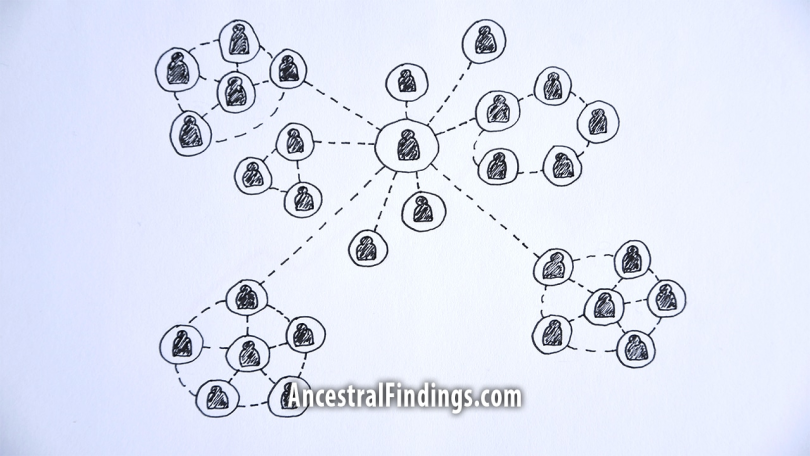
Think of it like this. Your ancestor is the center of a small web. The web is made of the people around him. If you can recognize the web, you can recognize the person.
Build an associate ledger so you can actually see patterns
Most researchers already copy extra names into notes, but the names end up scattered across pages and documents. That makes it hard to notice repetition.
Fix that by creating one running ledger for associates. It can be a simple list in a document, a spreadsheet, or a notes field in your software. The format is less important than the consistency.
Each time an associate appears with your target person, record these details.
The associate’s name exactly as written.
The role, such as witness, bondsman, surety, appraiser, administrator, buyer, juror.
The date.
The locality detail if present, such as district, creek, township, church, or road.
The source, meaning what record it came from.
You are building a tool that shows repetition. The ledger is where the repetition becomes visible.
Start with the records that naturally produce meaningful associates
Some record types are built to show relationships and local trust. Those are the best places to start, because the associate names tend to mean something.
Marriage bonds often include a bondsman or surety. That person is usually taking financial responsibility, so the bondsman is often a relative, close neighbor, or trusted associate.
Deeds usually include witnesses, and often an official who took the acknowledgment. Witnesses and officials tend to repeat within a neighborhood.
Probate files include administrators, executors, bondsmen, sureties, appraisers, and buyers at estate sales. These names are often drawn from the immediate community circle.
Court records can include lists of jurors, road crews, court appointed tasks, and civil actions that name both sides and their sureties.
Church records can include trustees, elders, sponsors, members received, and members dismissed or transferred.
Newspapers can produce networks through legal notices, estate notices, trustee sales, and court notices, often naming local officials and neighboring landowners.
These sources are valuable because the associate names were selected by local people who knew who they could rely on. That is exactly what you want when the main name is shared.
Not every associate has the same weight, so treat roles differently
In same name research, the biggest trap is assuming every extra name is equally important. It is not.
Some roles tend to point to a real relationship or close tie. Other roles can be routine.
A bondsman on a marriage bond is often meaningful because it involves responsibility. The same is true for sureties on probate and court bonds.
An appraiser for an estate is often a local man trusted by the court. Appraisers tend to be neighbors or men with standing in the community.
A witness on a deed can be meaningful, but you have to check whether that witness appears across many unrelated deeds. If the witness shows up everywhere, the witness may be acting as a routine functionary and the name may not separate candidates well.
A buyer at an estate sale can be highly useful when the same buyer names repeat, because the buyers are often relatives, neighbors, or business partners who were close enough to attend.
A lawyer can sometimes be less helpful for identity by itself because one lawyer might represent many clients, but the lawyer can still lead you to a case file that names local associates more clearly.
Role tells you why the person is in the record. That helps you decide whether the name is a strong identity marker or a weaker clue.
Use repetition as your main test
One appearance is a lead. Repeated appearances create proof.
If you see the same witness name appearing with one candidate again and again across multiple years, and you do not see that witness name appearing with the other candidate, you have the beginnings of an identity fingerprint.
Repetition can be direct, meaning the same associate appears with the same candidate repeatedly.
Repetition can also be layered, meaning the same associate appears in different roles connected to the same candidate. For example, a man might witness a deed, then appear as a surety on a probate bond, then appear as an appraiser in the estate. That layered pattern is rarely accidental.
Most of the time, the useful fingerprint is not huge. It is often five to fifteen names that keep repeating in meaningful roles.
Build an “associate fingerprint” for each same name candidate
When there are two people with the same name, you need a separating pattern for each one.
An associate fingerprint is simply the small set of repeated, meaningful associates tied to one candidate through records.
Start by keeping two candidate folders or two candidate note streams. At first, you may not know which associate belongs to which candidate. That is fine. You can leave associates unassigned until something anchors them.
Over time, one cluster of names will attach to one candidate through locality and repetition. Another cluster will attach to the other candidate.
Once the fingerprints form, you can place new records faster. If a deed for “William Johnson” is witnessed by the same two men you’ve already seen with Candidate A, that deed probably belongs to Candidate A.
This is how you stop guessing.
How marriage bonds and sureties can separate two men fast
Marriage records are often where confusion starts, because names repeat and databases surface multiple entries that look plausible.
Marriage bonds can help because the bondsman is often a key tie.
Here is a common scenario.
You find a marriage for Thomas Brown to Elizabeth Carter, with bondsman William Carter.
You find another marriage for Thomas Brown to Mary Collins, with bondsman Samuel Collins.
At first glance, you might think one man married twice. That might be correct. Or these could be two different men.
Instead of deciding immediately, you use the bondsmen as anchors.
If William Carter appears repeatedly in deeds near one neighborhood where one Thomas Brown appears, that connects that marriage to that candidate’s circle.
If Samuel Collins appears in court minutes, road orders, and other records linked to a different neighborhood where the other Thomas Brown appears, that connects the second marriage to the second candidate’s circle.
The bondsmen do not solve the case alone. They point you toward the right network, and the network separates the candidates.
How to use deed witnesses without fooling yourself
Deed witnesses are one of the fastest network builders, but you have to separate meaningful witnesses from routine witnesses.
Some witnesses appear constantly because they are clerks, justices, or men who happened to witness many deeds. If a witness name appears all over the county in many neighborhoods, that name is less useful.
Here is the practical test.
If a witness appears with one candidate repeatedly, mostly in one area, and does not appear broadly across unrelated deeds, treat that witness as meaningful.
If a witness appears everywhere, record the name, but do not rely on it heavily for separation.
Also pay attention to witness pairings. If the same two witnesses appear together repeatedly with one candidate, that pairing can be a strong marker.
The same goes for the official who took the acknowledgment. Justices of the peace often served limited areas. A repeated justice name can reinforce locality and help separate candidates.
Keep associate research manageable with a two step method
This method can feel endless if you chase every name into a full research project. You do not need to do that.
Use a simple two step approach.
First, extract every associate name from your target person’s records when the associate appears in a meaningful role.
Second, only expand research on the associates that repeat, or that appear in high weight roles such as bondsman, surety, administrator, executor, appraiser, guardian, or consistent neighbor cluster.
That keeps your time focused on the names most likely to separate candidates.
Often you only need one or two extra facts about a repeated associate, such as where they lived, who their spouse was, or what district they appear in.
Build mini profiles for the associates that matter
Same name confusion can happen to the associates too. If you mix up the associate, you lose the value of the network.
To prevent that, create mini profiles for your key associates. A mini profile is not a full biography. It is just enough to tell one person from another.
A solid mini profile usually includes the locality, the time range the person appears, one or two record types they appear in, and one stable link, like a spouse name or a consistent district.
When the associate name is also common, treat it like you treated the main problem. Separate the associate into candidates until the network clarifies which is which.
Separate business ties from family ties, then use both
Not every repeated associate is kin. Many are neighbors, business partners, or civic ties.
Those ties still separate candidates because the circle of trust in a community is usually stable. A person tends to borrow money from the same circle, witness documents for the same circle, buy and sell land within the same circle, and serve on civic lists with the same circle.
Family ties can be stronger when they are clearly supported, such as a bondsman who can be shown to be a father or brother.
The mistake is thinking only kin is useful. In same name cases, neighbors and associates often do the heavy lifting.
Use civic lists as network records
Road orders, jury lists, militia lists, and similar civic lists are often ignored because they do not name relationships directly. For same name work, they are often excellent.
These lists were typically drawn from a local pool. The same names can repeat in the same district or captain’s company year after year.
When you find your target person in these lists, extract the names around them. If the same men repeat alongside Candidate A but not Candidate B, you have separation.
These lists also help because they can exist in years where other sources are thin.
Probate networks can identify a man even when heirs are not clearly stated
Probate is often used to name spouses and children. In same name identity work, probate can help even when it does not clearly state relationships.
The names of the administrator, sureties on the bond, and appraisers often come from the immediate community. Those names can attach the estate to a neighborhood cluster.
If you can match that cluster to other records connected to one candidate, you can place the probate file correctly.
Also watch estate sale buyer lists. Repeated buyer names often point to relatives, neighbors, or close associates. Those names can strengthen the fingerprint.
Use associates as finding aids when your searches stall
Associates do not only prove identity. They help you find records you missed.
If you cannot find your target person in a certain year range, look for a repeated associate. Search that associate in deed indexes, tax lists, court minutes, or newspapers.
Because associates are part of the same community circle, their records often intersect. Your target person may appear in the associate’s papers as a witness, a buyer, a neighbor, or a party to a transaction.
This is especially helpful when your target person’s name is so common that database searches return too many false hits. Associate names narrow the search.
How to write up your conclusion so it stays clear later
Once you have separated two same name candidates using associate fingerprints, document it clearly.
State which associates belong to Candidate A and which belong to Candidate B, based on repeated appearance in meaningful roles and consistent locality.
Then mention the strongest roles, such as bondsmen, sureties, administrators, appraisers, and repeated deed witnesses, because those are easy for readers to understand as real ties.
You do not need a long argument. You need a clean, checkable explanation that shows why the records fall into two distinct community circles.
That write up becomes your guardrail. It keeps you from merging records later, and it lets someone else follow your logic.
The payoff
This method does three useful things at once.
It reduces wrong attachments when names are common.
It makes your searches more efficient because associate names guide you toward the right clusters of records.
It strengthens your proof because your conclusion is built on repeated patterns, not one fragile detail.
When you use witnesses and bondsmen well, you stop treating your ancestor as a name in a search box. You treat the ancestor as a real person in a real community, and that is where identity shows itself most clearly.